Friday, June 20, 2014

Appreciate the Time We Have

Just before we left on this trip to Israel, my family found out that we just lost my great-grandmother. She was the eldest living person in my father's side of the family.

While I didn't get to spend a lot of time with her (since she lived in South Korea), I was lucky enough to have met her once in 2012 when I was about 10 months old.

Not to toot my own horn, but I was her first (and only) great grandchild, so it was kind of a big deal for both of us. That same night, while we were all sitting around, I decided to show my appreciation by taking my very first steps with my great-grandmother watching. Needless to say, people were quite excited that evening.

That same 2012 trip to South Korea, I also saw my other paternal great-grandmother. From the first moment, she and I hit it off immediately like kindred spirits.

But unfortunately, she passed last year as well after a long and colorful life included getting separated from her husband and children when the Korean War broke out and then finding a way to sneak down to South Korea with my infant grandfather in her arms.

Since my parents' relatives are each from halfway around the world in either direction, we're going to have to fly a lot to see the extended members of the family. Despite the long international flights, the time zone differences and other hassles of traveling, we're going to continue making it a priority each and every year, because you never know when it will be the last time you see someone.

And fortunately, I'm here in Israel for another few days so I can enjoy my time with my last remaining great-grandparent. She was eldest of 4 children orphaned during the Holocaust.

Somehow, by the grace of God, she and her siblings survived, grew up and each started families of their own. Hardship and tragedy followed some of them, but they didn't complain and continued onward. Today, my great-grandmother is a proud reminder that the will to live starts at a young age and continues on through the twilight of your life.

She's known me since I was just 4 months old, and I'm just thankful I've been able to see her at least once a year.

Thursday, June 19, 2014

Israeli Street Food

Well known fact. My father and I love to eat. He would NEVER use the term "foodie" though, because he considers most of them to be mindless American lemmings fooled by the restaurant-media-pop culture into paying excessive premiums for adjectives like "Kobe" or "heirloom" or "grass-fed." My father prefers meals where the verbal descriptors are "finger-lickin' good!"

He's developed a taste for more simple cuisine that is more indigenous to the region we're visiting. For example, dim sum when in Hong Kong, grilled fish in Costa Rica, schnitzel in Germany, Waffle House in Alabama. You get the idea - basically, "When in Rome..."

But yes, I realize that makes my father no different from any other doofus with a passport. I suppose he's not, but when we travel abroad, we find ourselves most fascinated by (a) the grocery stores/markets and (b) the late night food.

Market Food
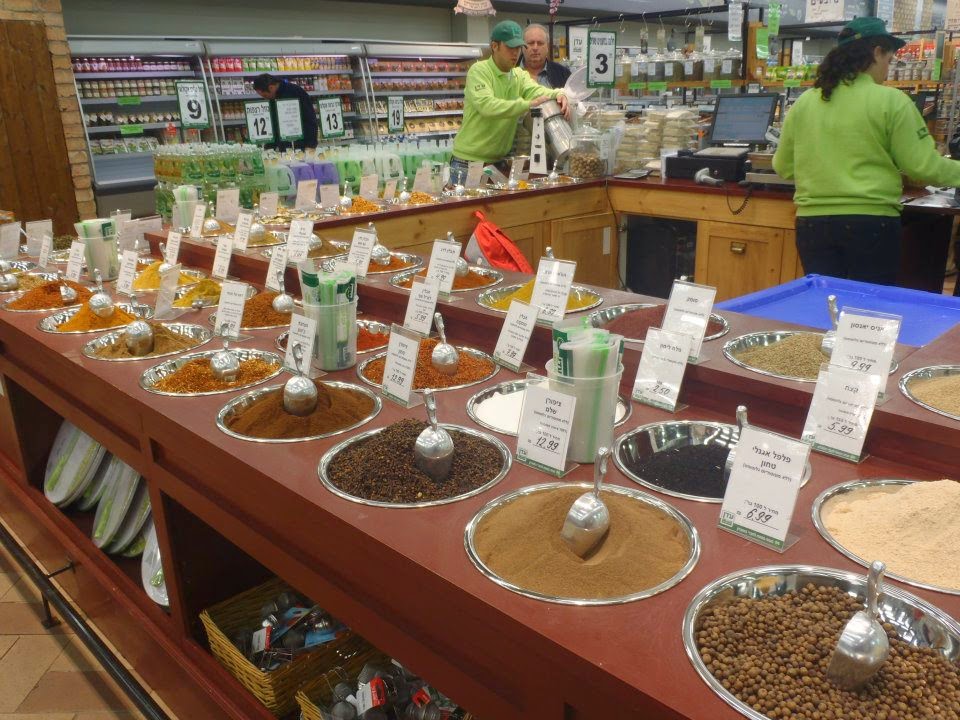
Every grocery store around the world has the same basic purpose, but the novelty of certain local items, consumer marketing and unique items make a visit to the market a pretty interesting one to someone like my father.

In Israel, one of my family's favorite purchases at a grocery or bakery is the bourekas. While Wikipedia says they originated in Turkey during the Ottoman Empire era, they're quite ubiquitous in modern day Israel as well. My father first tried them when he was visiting my mother during their 8 month courtship phase and instantly became a big fan.

These thin, flaky dough pastries aren't desserts though. Instead of sweet fillings, they're loaded with savory items such as mushrooms, spinach, potatoes, salty cheese and even a "pizza" filling. Apparently to standardize the bourekas, they passed a rule where each shape corresponds to a specific filling, so that no one gets any surprises.

In terms of size and price, most of the places we frequent here sell the smaller sized versions (about the size of your computer mouse) and you pay by the weight. Depending on the bakery/market, you can get about 12 or so pieces for about $10 USD. And 3-4 would be quite filling for most people on a normal feeding schedule.

Late Night Food
Late night food is something every young person all over the world can relate to. In New York City (the best city in the world), you have your pizza where $1 can buy you a slice of greasy heaven. In Chicago, singles who failed to bed someone that night find comfort in hot dogs. In Los Angeles...I have no clue, because we don't really like the nightlight social scene there, but I'd imagine it has something with organic avocado! In Tokyo, you have ramen noodle soups. In Buenos Aires, you basically have breakfast since nightlife starts at 2AM and you're out til 6-7 in the morning.

In Europe and the Middle East, however, we've found they like shawarma (aka, donor kebabs). Originating somewhere in the Middle East, shawarma is a local staple in Israel. Even if you've never tried it before, you probably have seen this column of mystery meat at some point in your life.

It's actually strips of seasoned meat (lamb or beef are the most popular here, but you can get chicken. Definitely no pork though) layered with chunks of fat for flavoring. My father doesn't care for the chicken, so we always go with lamb when possible. Our favorite place? Amir's Shawarma across the street from Lev HaMifratz Mall. It's just very clean, well run and has (shockingly) great customer service - almost unheard of in Israel.

When you order a shawarma, they pull out a knife or an electric carver and cut down the side (like shaving the meat column). The chunks of loose meat fall onto a plate to be used as filling.


Depending on how hungry you might be, there's a choice of a single serving pita size or a double serving kebab (looks like a huge burrito). To give you a sense, my father usually goes for the pita size, and it's more than enough for his voracious appetite.


You then have your choice of toppings including sauces (hummus, hot sauce, tahini) and vegetables (cabbage, onions, tomatoes, cucumbers, parsley).


I'm not sure how it's done elsewhere, but in Israel, they also give you a free side salad from their salad bar including pickled cauliflower, pickled carrots, hot peppers, and pickles. It's also popular to order a side of french fries as well. I suppose if you're gonna eat greasy fatty food late at night, might as well go all the way. When in Rome...


Wednesday, June 18, 2014

Our Travel Wallet

Over a year ago, my father was kind enough to open up his wallet with my LCD readers. There, he offered an inventory of all the various credit cards he and my mother currently had open (though not all of them were actively used).

Big warning! We are not suggesting that any of you fine upstanding readers follow my crazy parents down this financial rabbit hole. Unlike the popular bloggers, we don't get paid if you sign up for credit cards. 

If you have any outstanding debt at all (student loans, credit card, personal loans or mob gambling debt), then you're better off not opening more credit cards, because you're probably spending more than you're making and ruining your future. The interest charges alone will destroy any point/mile value you may receive. The last thing you need is another credit card.

Recall, there are 3 different types of reward credit cards.

A. One Night Stands (for the sign up bonus)
B. Booty Call (ongoing benefits)
C. Marriage (bonus spending)

Despite having 33 open credit cards from 7 different banks, we only regularly use 8 of them each month (Booty Call). And of those 8, we primarily use just 4 of them (Marriage). The remaining (One Night Stand) cards sit quietly in a zip lock bag hidden somewhere where my toddler hands can't get to them.

Which three cards does my father keep in his excessively slim wallet? Well, I'm glad you asked...

1. Amex Blue - earns 5% cash back on all spend at gas, grocery and drugstores.
2. Citi Thank You Premier - earns 3x on all restaurant spend
3. Amex Starwood - earns 1x on all regular spend and 2x on Starwood Hotel spend (our personal favorite)
4. Chase Ink Bold - earns 5x on internet, cable, cell phone and office supply stores and 2x on hotels and gas


The above lineup is his regular "starting rotation" when he's in the United States.

Sidenote: I tried to find a photo with the 2014 Yankees starting rotation, but there weren't any magazine covers including David Phelps, Chase Whitley, Vidal Nuno with the regular starters Hiroki Kuroda and Masahiro Tanaka.

I qualify that this is his US wallet because a few of these cards aren't as rewarding when you step outside America. The two American Express cards charge an additional Foreign Exchange (FX) fee of 2.7% when used abroad. Since my father hates sub-optimal outcomes within his direct control, he sits those cards on the bench whenever he grabs his passport.

So on this current trip to Israel (via Switzerland), we had to re-shuffle the deck a bit. Kind of like when the Yankees are in the playoffs and are facing a dominantly left-handed batting lineup.

Both the Citi Thank You Premier and Chase Ink Bold were created for travelers so they don't have FX fees. Since we do plan to eat while traveling, we were definitely keeping the Thank You card. However, we use the Ink Bold card primarily for utilities at home and small businesses expenses at Staples, so we left that card at home as well since our monthly cable/internet bill is set on auto-pay anyway.

So out of the 4 card slots, we had 3 open.

First, we needed an ATM card to access cash. So we took our Charles Schwab ATM card which as I mentioned before does not charge any ATM fees worldwide. We've found getting cash from a reputable foreign bank's ATM is the best exchange rate.

Second, we needed a FX fee-free Mastercard to pair with our Citi Thank You (Visa). Fortunately back in March, my father applied for the Barclays Arrival+ World Mastercard which offers a very interesting rewards program where you basically get 2.2% back in the form of travel spend credits.

Every charge you make earns you 2 Arrival miles which can be used to redeem against travel expenditures at $0.01 per mile. But then you also get 10% back. The Arrival miles program is exceptionally easy to use and travel redemption can be put on charges we just made, even though the monthly statement hasn't closed.

In fact, this week we used 5,000 Arrival miles to remove $50 from the Zurich taxi charge from last week and then instantly received 500 Arrival miles back (10% rebate). My father really underestimated this card, but the Arrival+ could be our Masahiro Tanaka - a new surprise addition that is really paying off!

Third, we had a utility slot available. No specific needs on this final card, so we went back and told our veteran workhorse American Express Starwood card that we changed our mind. While we wouldn't use this card at any foreign locations, invariably, there are times when my parents need to make an online charge based in the United States (daycare, medical bills, shopping, etc). Since those transactions would be processed in America using US dollars, the 2.7% FX fees wouldn't come into play at all.

So there you have it, the starting international rotation:

1. Citi Thank You Premier Visa - for all restaurant spend or where only Visa is accepted
2. Barclays Arrival+ Mastercard - for all other international spend or where only MC is accepted
3. Schwab ATM card - for cash withdrawls in local currencies
4. Amex Starwood card - for any US-based transactions that we need to make while abroad

Now, if only my father would agree me to add this adorable little kitten to my rotation.


Tuesday, June 17, 2014

Haifa Beaches

When people think of Israel, my father says they imagine a scene from a really old movie called The Ten Commandments where a bunch of people escape Egypt to wander around in the desert led by a Bohemian hipster named Moses.

I haven't seen the movie because it's not on the Disney Junior channel, but I heard it's a famous story that just about anyone born in the 1970's would know. However, the film seems to paint a pretty desolate picture of what is today known as Israel. Endless desert. Rugged mountainous terrain. The Dead Sea.

The funny thing is (having been here a few times) when my family thinks of Israel, we think of beaches. Miles and miles of stunning clear Mediterranean water with powdery white sand. Here's a more recent photo of Israel so you can see the difference between myth and reality.


Within the country of Israel, there's obviously the famous cities of Jerusalem and Tel Aviv. Then you'd probably think of the Dead Sea region followed by Eilat if you're more Red Sea than Dead Sea, but you can't forget about my mother's hometown of Haifa in the northern part of the country.

As the third biggest city in Israel, Haifa is known for the caves where the prophet Elijah lived, the Baha'i Gardens and Mount Carmel. But Haifa also has multiple wonderful beaches as Google Maps loves to point out.

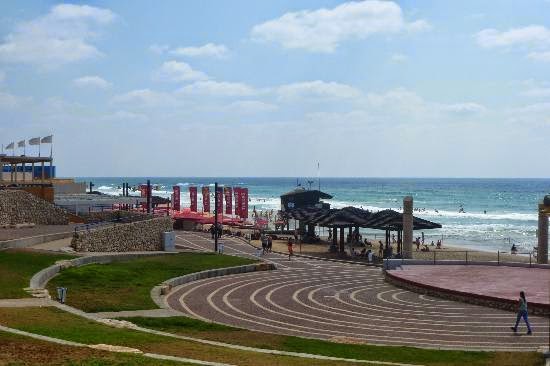
My mother's favorite beach when she was growing up here was Dado Beach (the dot furthest south on the map, just below Carmel Beach). In the past few years, the local municipality really invested in its infrastructure and built up a promenade at Dado Beach so that pedestrians can walk along the beach, stopping along at a restaurant or cafe as they meander down the coast.


The best part - there is no retail shopping (ie, stores that sell trashy "Your Boyfriend Thinks I'm Hot" tank tops) that would attract the Jersey Shore type of crowd. Instead of steroid infused bros here, you're more likely to find older overweight grandfathers wearing speedos (no photo necessary). But with free public parking, benches, cafes, clean public bathrooms, free showers, pubs and frequent sitting areas, Dado Beach really is for everyone - from young singles to families with kids to aging retirees.

The other day, my parents decided to ditch me with my grandparents while they snuck out for a beach day. Hopping the public bus, they were at Dado Beach in about 30 minutes. The entrance they use always stands out to me because it has the Camel Bar & Restaurant (with its blatant infringement on the popular American cigarette brand) as soon as you hit the promenade.

From there, they usually walk north along the paved walkway, passing by a few restaurants and pubs along the way to pick up a beer or ice slushee. Apparently, you can drink alcohol in a plastic cup in public. But since Israeli's don't really drink (well, not as much as Americans), it never becomes a big issue.

My mother and father usually skip the section of the beach that is directly in front of the larger restaurants (with its padded restaurant seating on the sand) as that area is more of a singles scene for the pseudo-socialites of Haifa. Then they pass the regular beach section where the families frequent with their kids running around all over the place and Israelis playing their paddle ball.


My parents keep walking, past all the action, but never unsure of the destination. Since my mother grew up there, she knew exactly where she was heading. Finally, they reach the spot where it's roped off due to the strong under current. It's a little quiet spot on the beach where my father won't get stares because he's a beautiful Asian man. There, they plant their butts down and enjoy the amazing beach.


After a few lazy hours of swimming, napping and tanning, they shower quickly in the public bathrooms (which are remarkably clean as far as public beach bathrooms go) then walk back down the promenade to a beach-side restaurant with passable food, but a comfortable outdoor seating arrangement.

Seasons Restaurant offers a smoking section for those interested in a little hookah (not to be confused with a midget prostitute) as well as standard Israeli food (shakshuka, falafel, hummus, schnitzel, etc). It seems every time my parents go to the beach, they end up at Seasons.

Even though the menu isn't that appealing and the prices a bit higher than you'd expect (33 NIS - almost $10 USD - for a Stoli vodka drink), they can always find a seat outside in the shaded patio area where they can people watch and relax. And my father never really turns down an opportunity to eat a little snack, no matter how mediocre the food is.


Monday, June 16, 2014

Need Ideas To Spend Our American Airline Miles

As most of you LCD readers know, my family is pretty loyal to United Airlines. That being said, we do keep up to date with what goes on in the industry - such as the American-US Airways merger.

The reason we care about the merger is because in addition to the United miles we have earned, my family also has over 480,000 AA + US miles combined. That's enough for 3 round trip flights almost anywhere in the world all in FIRST class on any airline in the OneWorld Alliance, including Cathay Pacific, British Airways, LAN and Qantas as well as some codeshare partners such as Ethiad.

If you're not that familiar with the difference between business class and first class, then let's take a moment to clear things up a bit.

When Americans fly domestically in "first class," the seat and experience are probably closer to what international flights would consider business class. Domestic first class passengers get a marginally larger seat that reclines a bit more, additional leg room and an in-flight meal with free alcoholic beverages (beer, house wine, mid-tier spirits).

Perhaps they even get a shorter line to wait at check-in and at TSA security, but everything will basically look and feel exactly the same as the economy check in and security lines. This domestic "first class" is NOT what we're talking about here.

True international first class starts from the moment you arrive at the airport. Many of the foreign airlines have radically unique first class check in areas; some even with completely standalone first class terminals that look more like hotels than airports. Even further, some of the Middle Eastern airlines also offer their first class passengers a free chauffeured ride from their hotel/home to the airport.

Then after you check in, you head over to the First Class Lounge where you have access to higher end meal options, including a proper dining area that looks more like a restaurant. Again, think luxury hotel level features and amenities. For a detailed review of the world's best First Class Airport Lounges, check out OneMileAtATime's posts (Lufthansa in Frankfurt, Emirates in Dubai, Air France in Paris, Ethiad in Abu Dhabi, and Thai Airways in Bangkok).


Some airport terminals (especially those where that airline has a primary hub such as Lufthansa in Frankfurt or Thai Airways in Bangkok) will have additional first class passenger features such as a full bathtub to unwind between flights, a mini spa where you can get a free massage, or even a ride in a Mercedes across the tarmac to your plane.


And that is all before you're personally escorted onto the plane as the very last passengers to board. The entire flight will wait for you.

And since you don't need to secure your shared overhead space for your carry on, you can avoid fighting your way onto the plane with the "gate lice" who can't seem to comprehend the concept of a line.

Then when you board, you are personally identified by the first class cabin crew (usually the highest performing staff) who is staffed at a much more favorable crew-to-passenger ratio than in the other cabins. In fact, out of the 8-12 first class seats on a flight, there's a strong chance that only 2-4 of the seats will be taken so you may be outnumbered by the first class crew.

Then we get to the difference in seats. As you can see in the photo on the left, the Cathay Pacific business class seats are plenty comfortable. But when you see the Cathay Pacific first class cabin on the right, you can see that a single first class seat can actually fit two full-sized adults comfortably.


Now this is literally the definition of a first class problem, but the seats are set up to give a single passenger as much space as possible. That'd be great for the solo business traveler, but probably less so for a family with a young (but adorable) toddler. Somehow, I think if my parents and I were lucky enough to score 3 seats in first class, we would find a way to make it work.

So where should we go in 2015? We could try for Qantas to Sydney...

Or Ethiad to the Maldives...

Or British Airways to Dubrovnik...

Or Cathay Pacific to Boracay...

Or LAN to Rio de Janiero...

So many great choices!  Now we just need to find some vacation time from Five Star Painting IL.

Friday, June 13, 2014

The Cure for Jetlag in Israel - Tiberias Hot Springs

So as some of you may know, my family is pretty... "multi-cultural." My father is of Korean descent but grew up in New Jersey. My mother is part Uzbek-part Russian and grew up in Israel.

By grandparents still living in Haifa (#3 city in Israel), we go to visit them at least once a year. My first three times were chronicled already:

1. March 2012
2. January 2013
3. September 2013

But since we had a few weeks of downtime this June, I asked my father to go visit again since it's been about 9 months since I was there last and I learned a few new tricks since the last time I was there (ie, I can talk now).

Our first day (Wednesday) was actually a catch up day. Our red-eye flight from Zurich landed in Tel Aviv just after 3AM. By the time we passed through Immigration and collected our checked luggage, it was closer to 4AM. Then we had a 2 hour drive to Haifa so we didn't get to my grandparents' place until 6AM. Needless to say, we were pretty tired from the traveling. Despite showering to wake up, my father went to lay down after breakfast and passed out til about 4PM. I guess jet-lag is tougher to overcome now that he's getting older.

The next morning (or rather late the prior evening), I woke up and didn't want to go back to sleep. So at around 3AM local time, my father ended up entertaining me til about 5AM when I finally went back to sleep (which made sense because that would have been 10PM in New York).

Again, my father's sleep was still off cycle, so he just decided to get up at 5AM and start his day. By 11AM, however, he was tired, so took a long 3 hour nap. Fortunately, there weren't any plans that day either. That night, however, I managed to sleep through the entire night normally, which undoubtedly helped my father get back on a regular sleep schedule.

Friday was our first day of any substantive activity. We all woke up at 8:30AM and got in the car by 10AM to go to Tiberias (a city on the western shore of the Sea of Galilee - yeah, the one from the Bible) where they had some Hot Springs. As you can see from the map, it's about an hour drive east from Haifa passing the town of Nazareth (as in "Jesus of...").

The town of Tiberias is a resort destination for Israeli locals looking to get away. Besides being located along the Sea, Tiberias is also famous for having hot mineral springs that are said to have mystical skin curing abilities. The hot waters contain high amounts of sulfuric, hydrochloric acid, and calcium salts, and over the centuries they've reportedly cured skin problems and such ailments as rheumatism, arthritis, and gynecological disorders. And of course, there were also some commercial tourist oriented water parks, hotels and restaurants lining the coastline as well.

My family arrived around 11AM and we were able to claim seats in the shade among all the elderly retirees who had been there much earlier than us. Apparently, there were ancient ruins that we could have seen as well, but we didn't know about those while we were there.

Instead, the place looked more like a town swimming pool complex with a few different pool options - a traditional cold water pool, a kiddie pool and the connected outdoor/indoor heated hot springs (which just looked like a big pool). I thought they could have done a better job making it look more like an ancient Roman bathhouse, but I suppose, 1970's style tile was easier to maintain.

Since we were not guests at any of the nearby hotels, we had to pay an admission fee. My grandparents paid for us, so I'm not sure exactly what the prices were (and there's no website for us to look up), but my mother said it was the Israeli Sheckle equivalent "around $100 USD" for the 4 adults and 1 toddler.

The entire complex was quite simple, but kept very clean. As we'd find out later on, the Tiberias Hot Springs & Spa is very family friendly and attracts a nice mix of elderly couples, young singles as well as families with young kids. By 1PM, the place was pretty full.


But as you can see, at 11AM, the younger crowds had not yet arrived to occupy the cold water pool.


The hot spring pool, however, was buzzing with old people activity. The water was quite warm (like about 95 degrees Fahrenheit). The high concentration of minerals in the water was definitely noticeable, as your skin felt very slippery (similar to how my father felt in the Dead Sea). On the inside end of the indoor pool area adjacent to the locker room areas, there were some hot sauna and steam rooms available as well.


Additionally, back towards the front entrance, there was a traditional spa area where you could have massages and other spa treatments. My father inquired about an hour massage and it came out to NIS 350 (or about $100 USD).

While my parents enjoyed their time in the heated mineral pool and the regular swimming pool, I spent much of my free time chasing after the cats they had all over the complex and playing with my grandmother in the small outdoor kiddie pool. Fortunately, the kiddie pool had a cover to shade you from the hot Israeli sun. Otherwise my alabaster Asian skin would have turned lobster red.

In terms of refreshments on site, there was an outdoor bar serving beer and spirits as well as a traditional snack bar offering hot dogs, french fries and soft drinks. In typical fashion, my grandparents had already packed us lunches from home, so we were quite set on food and avoided the overpriced snack bar for the most part - though I did manage to get a few ice creams throughout the day.

And as for my father's jet lag...well, let's just say that it wasn't 100% cured as he took a long 2 hour nap.